- Culture Vibrations
- Posts
- Professor Shivani Sharma: Kathak Dancing and Preserving Punjabi Heritage In UK
Professor Shivani Sharma: Kathak Dancing and Preserving Punjabi Heritage In UK
Discover how Professor Shivani Sharma uses Kathak dance to embrace her Punjabi heritage, overcome childhood challenges, and stay connected to her roots.

Liana Yacob
December 21, 2025

Professor Sharma dancing to the Indian classical form of Kathak. (Photo credit: Simon Richardson)
Professor Shivani Sharma, 40, was born to Indian parents who emigrated to the UK from Punjab in the 1970s and describes her Hindu family as ‘forward-thinking’.

Shivani as a baby
She grew up in London, UK, where as a child she experienced verbal and physical bullying due to being one of the only pupils of colour in primary school.
Her secondary school experience was much more inclusive and welcoming for her as she excelled in her studies.
Shivani credits her successful career to the way her parents have raised her to embrace both her Indian heritage and British culture.
“I am really grateful to my parents for the balance between British and Asian culture that runs through my everyday life,” Professor Sharma said.
“This has enabled me to experience the richness at the intersection of heritage.
“There are times however at which striking this harmony has not been so straightforward.
“In my childhood, the environment in which I attended schooling was not diverse, and children I found could be quite mean based on the colour of my skin.

Shivani as a child
“What I took from this was some sort of resilience to pick myself up when things were tough.
“Equally, the independence I craved as a young adult, culturally as a woman, was difficult for my parents who offered my brothers far more freedom.
“However, with my culturally informed mindset, I’ve always understood the reasons that their outlook was different and found ways to use open dialogue to reach reasonable compromises.
“So, I would describe living in the UK as a South Asian woman as dynamic, negotiating identity in different contexts.”
There are many ways in which Shivani maintains her heritage and culture, particularly with her own family.
“Food, language, music and values are an everyday mechanism to keep the Asian in British Asian culture alive in our household,” she said.
“We also try to visit India to spark curiosity in history and heritage.
“At this stage, given how young my children are, I hope that this grounding will sustain connection.

Shivani with her husband and children
“Certainly, when I look at my nieces and nephews who are a lot older, there are dimensions that they hold strong, so it isn’t inevitable that culture becomes diluted overtime, but it has to start with exposure.
“I have visited India several times, mostly since my early 20s. What I love most about it is the calm within the chaos of the busy streets of Delhi or Punjab.
“It deepens my appreciation for the vibrance of culture.”
Shivani’s parents have instilled core values and behaviours associated with their Indian heritage whilst also celebrating British culture, which she honours.
“My parents tried their best to hold on to core values and behaviours associated with Indian heritage whilst also embracing British culture.
“I really appreciate this as I reflect on my own approach to living at the intersection of cultures.
“I feel that the balanced approach they brought to parenting has enabled me to really enjoy and thrive in different cultural environments and to indeed experiment in bringing my own flare to unity too.
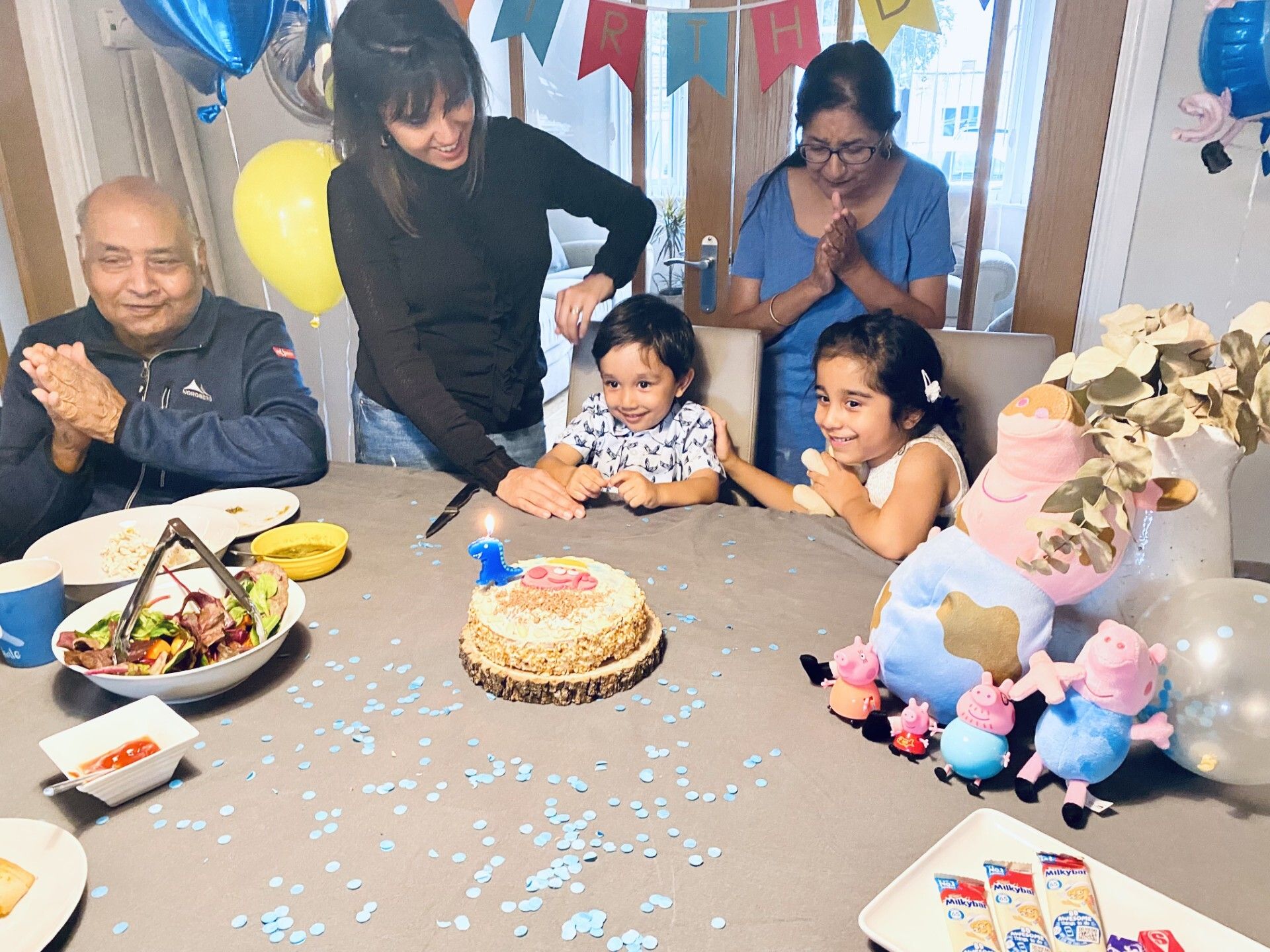
The Sharma family celebrating a birthday
“Religion is important to my parents, who both follow the Hindu faith.
“Some of the most vivid memories I have as a child are of attending weekly prayers and the wide range of culinary delights I’d get to try as part of this.”
Shivani connects to her heritage through her passion for the Indian classical dance form of Kathak, which she learns under the tutelage of Shila Mehta.
“Indian classical dance is a big part of my life and one of the ways in which this connection runs strong through performing arts on a daily basis,” she said.
“It encourages me to delve deeper into Indian traditions and values and shows up therefore in my approach to everyday life.
“I really connected to the sound of the tabla (drum) through this exposure.
“As an adult, this has influenced my pull towards pursuing training in the Indian classical dance form of Kathak.

Shivani dancing Kathak. (Photo credit: Simon Richardson)
“It uses the same percussion and its story telling elements often draw on Hindu mythology which I am aware of from my childhood attendance at prayers. And for sure, food remains a major source of connection to others.
“So just as my parents often hosted prayers and family events, cooking up a feast, I tend to do the same for my friends and family and even for work colleagues to make lunchtimes more playful.”
Kathak has a rich history in storytelling, Professor Sharma said.
“Kathak originates from the north and is one of eight classical dance forms from the Indian subcontinent,” she said.
“The word ‘Kathak’ comes from the Sanskrit ‘Katha’ which means story. The dance traces back to storytelling, typically mythological, in dance movement.
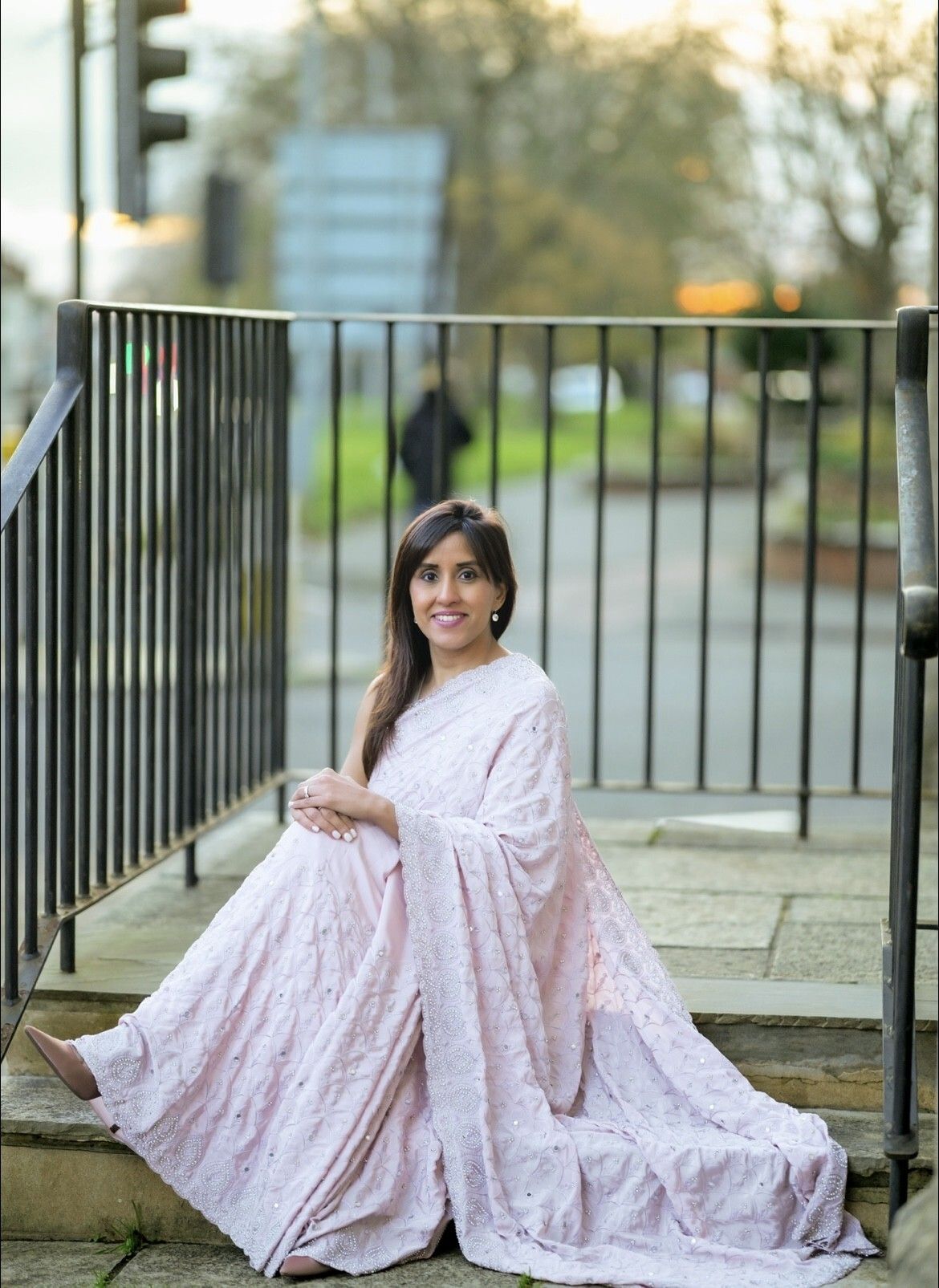
Shivani in her sari. (Photo credit: Polaroid Photography UK)
“It is now a rich blend of this communicative aspect along with abstract elements that empathises rhythm, contrast in speed, and aesthetics.
“I continue to expand the boundaries of being at the intersection of cultures. For example, I recently brought the theme of neurodiversity into Kathak dance.”
There are a couple of misconceptions of India Shivani wants to dispel.
“India is a diverse place,” she said.
“There can be a tendency to group Indian heritage into a homogenous cluster, which misses the unique contributions of diverse cultural communities.
“I’m certainly learning more and more about this myself, especially through my engagement in Indian classical Kathak dance.
“Secondly, as I was growing up, I was often asked about the classic arranged marriage and what this means for choice.
“I would always constructively clarify that for many people; this equates to facilitated introductions based on core commonalities and not a forced experience (at least in my family and community).
“That misconception is still held where we need a more nuanced understanding.”
Shivani is a professor in research and enterprise and deputy pro vice-chancellor at Aston University.
“My area of research focuses on health inequalities,” Professor Sharma said.
“This mainly emphasises factors in society that mean that some people experience worse health outcomes than others.

Professor Sharma with her family at a lecture she presented
“I often work with people who aren’t usually part of research, including those from South Asian backgrounds, particularly the elderly.
“Here my cultural grounding is important as it gives a unique lens of understanding and linguistic skills to bring to science so that our outcomes benefit a wider group of people and their health.
"I’d like to say that I had a grand plan of wanting to be professor or scientist, but it all happened by accident.
“One of my now mentors encouraged me after my undergraduate degree to pursue doctoral studies.”
Her parents’ emphasis on education helped shape her life today.
“My parents had a strong emphasis on education as a route to stability,” Professor Sharma said.
“That matched with observing my mum working hard and balancing so many things has really shaped where I find myself today.
“My mum rarely shared explicit life lessons, but I have through osmosis absorbed so many of her attributes - resilience, independence of mind, ability to self-start, care for others.”
When asked what she thought about the concept of asking uncomfortable questions to help us learn from each other and grow, Shivani said: “Authenticity is important.
“People don’t just want glossed versions of issues because that prevents learning and development.
“I am drawn towards those who share with honesty, particularly aspects of their career journey that have been less straightforward.
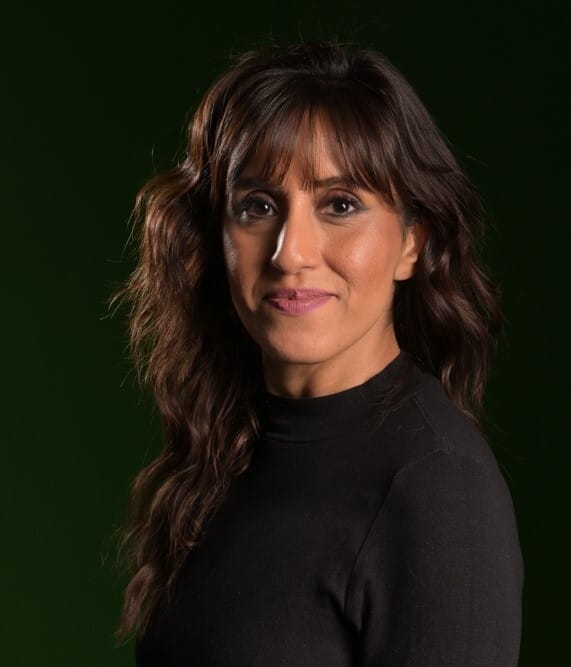
A headshot of Shivani. (Photo credit: Richard Battye)
“I have been fortunate to encounter many such people who I have learnt a lot from because they were happy to talk about or ask questions about difficult issues.
“I recall a now collaborator who once asked me in a packed room at a conference whether my research was time limited because at some point language barriers will stop being an issue in research.
“At the time I was surprised to be asked this but in fact what it did was to highlight issues in how we compartmentalise my subject - research inclusion.
“That helped me share reflections and to move mindsets overtime i.e. that the issue is more complex than language.”
Food has been a significant stepping stone in learning about her Indian heritage.
“My mum grew up in Kenya and so the Indian food we have has a twist to it,” Professor Sharma said.
“I only realised this influence after marriage, when my husband hadn’t ever tried some of the dishes in his Punjabi family and also didn’t understand a few words I would say because it was a mix of Punjabi and Swahili words.
“We always ate together at least until late teens when I went off to university and mostly Indian all week, with some pasta as a must too.
“This is why my staple go to is still dal (lentils) and rice. Food was a big part of extended family get together and cultural events - with everyone contributing something for a community vibe.”
Shivani, who currently lives in Oxfordshire, UK, with her family, volunteers for a community group called South Asian Performing Arts Centre.
“I have retained my emphasis on fundraising, but I also play a bigger part in shaping the scale at which we embed South Asian arts within the regional cultural scene,” she said.
“That means speaking to key arts organisations and working together on my larger projects where we can promote the visibility of performing arts from the Indian subcontinent.
“I am particularly driving that affordability and physical ability should not be barriers to this so that everyone can experience diverse cultural connections through dance and music.
“Every time we deliver an activity, I am reminded of how powerful arts are as a vehicle to bring people together.
“This motivates me to continue to drive for arts in general for social cohesion.
“I live and teach dance myself in a small village and seeing students from all cultural backgrounds engage, enjoy and grow shows that these forms transcend beyond entertainment into something that fuels cultural curiosity and connection.”
Reply